

How to Assemble Large Furniture in Small Spaces Without Damaging Walls or Floors
Fully Licensed & Insured
Safety is our #1 Priority
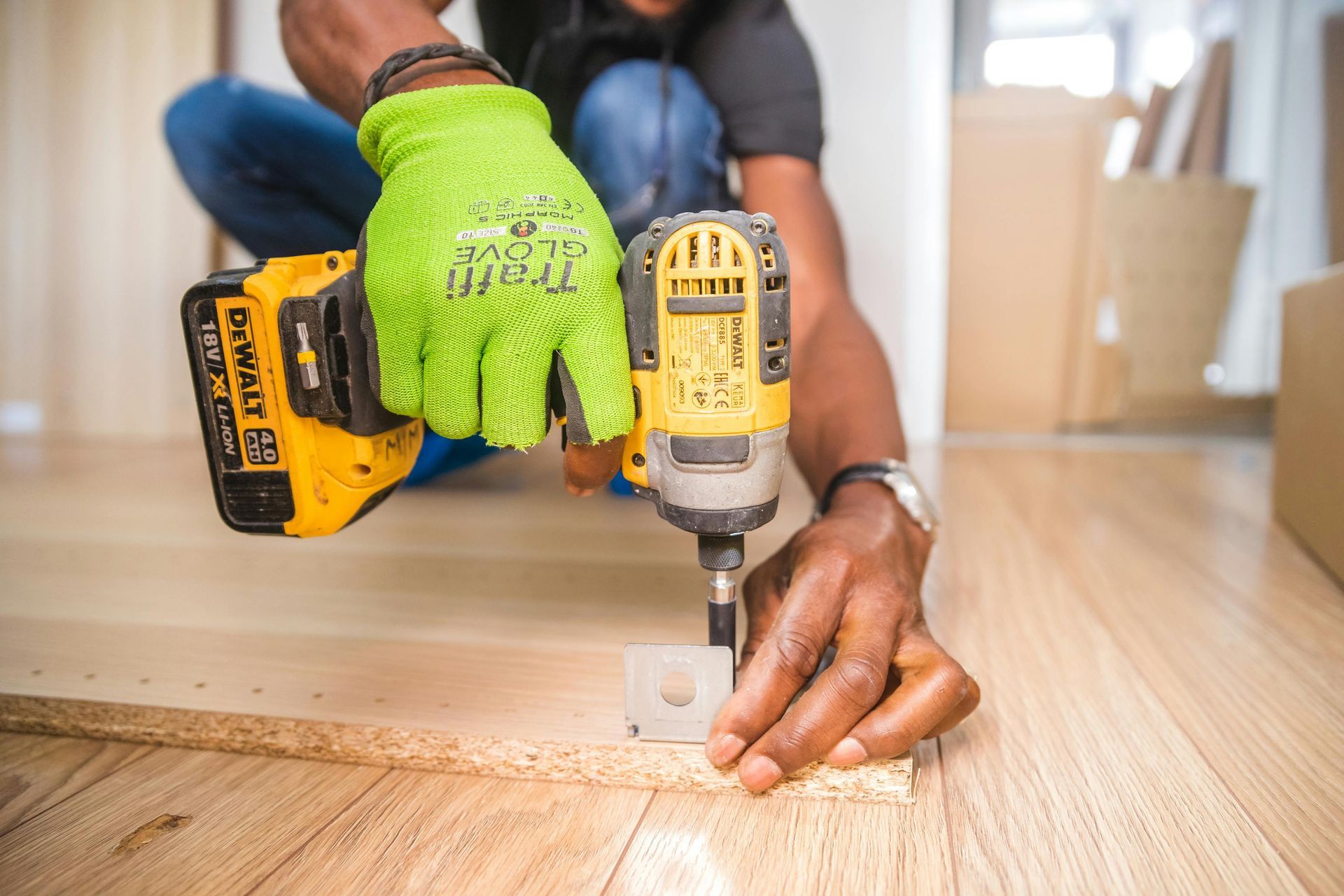
The Smart Way to Assemble Large Furniture in Small Spaces Without Damage
Assembling large furniture in small spaces is one of the most underestimated home challenges people face across Maryland, Washington DC, and Northern Virginia. Most people focus on finding the right piece without considering the limited room for maneuvering, the lack of proper tools, or the need for careful planning before a single bolt is tightened. Once the boxes arrive, the real difficulty begins.
Without proper preparation, walls get scraped, floors get scratched, and furniture ends up improperly assembled. These issues lead to costly repairs, unstable furniture that poses a safety risk, and significant delays in getting your home set up the way you planned.
That is where Any Assembly comes in. Their team specializes in tight space furniture assembly, using safe handling techniques and efficient methods to get every job done without damage or frustration. If you want your furniture assembled correctly the first time, professional help is the most practical decision you can make. Request a quote today and skip the stress entirely.
Why Assembling Large Furniture in Small Spaces Leads to Damage and Delays
Assembling large furniture in small spaces leads to damage because there is not enough room to safely handle panels, frames, or large components without contact with nearby walls and floors. Tight quarters force people to work at awkward angles, rush through steps, and skip the protective measures that prevent scratches and scuffs.
Large furniture like wardrobes, bookshelves, and bed frames requires a clear staging area during assembly. In small rooms, that staging space simply does not exist. As a result, heavy panels lean against drywall, drag across hardwood floors, or tip during repositioning.
Adhering to recognized furniture safety standards is essential during assembly, particularly in confined spaces where the risk of tipping and structural failure increases significantly. Most DIY assemblers are unaware of these guidelines and proceed without the stability checks that trained professionals always perform.
Beyond physical damage, improper assembly in tight spaces leads to misaligned frames, loose joints, and incorrectly installed hardware. These structural problems make furniture unstable and often require full disassembly and reassembly to correct.
Common Mistakes When Assembling Large Furniture in Tight Spaces
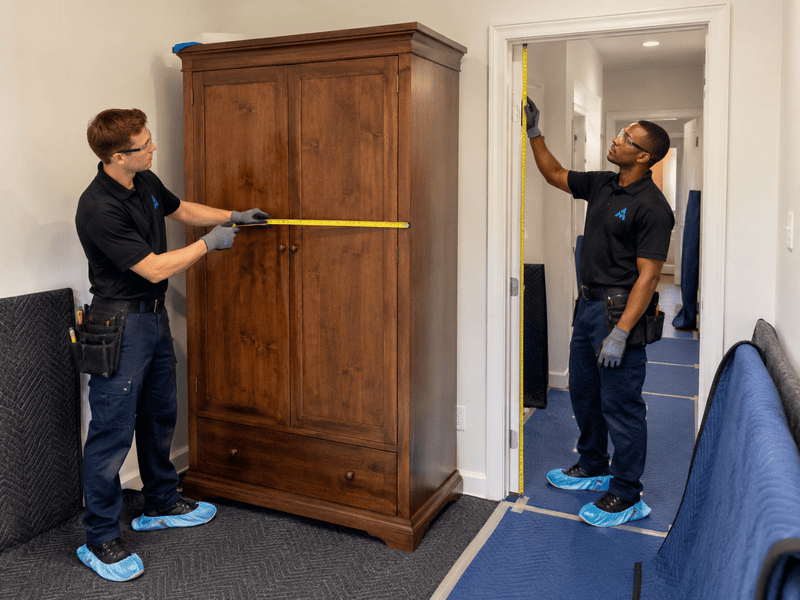
The most common mistake when assembling large furniture in tight spaces is starting without measuring both the furniture dimensions and the available room clearance. This single oversight accounts for the majority of wall and floor damage during home furniture setup.
- Skipping floor protection: Placing heavy components directly on hardwood or tile without padding causes deep scratches and gouges.
- Forcing panels through doorways: Carrying partially assembled sections through narrow openings damages both the furniture and the surrounding door frame.
- Using incorrect tools: Relying on the wrong screwdriver size or over-torquing with a power tool strips hardware and splits wood panels.
- Assembling before positioning: Building a large wardrobe completely outside the room and then attempting to move it through a narrow doorway almost always ends in damage.
- Working alone: Large furniture panels require at least two people to handle safely in confined spaces.
Popular retailers like IKEA provide assembly instructions, but those guides rarely account for the physical challenge of maneuvering large units through tight spaces.
Wayfair and similar online furniture platforms ship a high volume of large items to small apartments and condos every day. Without professional assembly, many of those deliveries result in damaged walls, scratched floors, and improperly built furniture.
How to Measure Doorways Hallways and Clearance Before Assembly
Measuring doorways, hallways, and room clearance before furniture assembly prevents the most common setup failures. Always measure the width and height of every entry point between the delivery location and the final room where the piece will be placed.
Begin by noting the assembled dimensions listed on the product page or manufacturer documentation. Reviewing global furniture compliance and dimensional standards helps confirm that product specifications are accurate before any assembly work begins.
- Doorway width and height: Account for door frames, hinges, and baseboards that reduce usable clearance beyond the raw opening measurement.
- Hallway length and width: Long panels may need to pivot through hallways, requiring more horizontal clearance than the hallway width alone suggests.
- Ceiling height: Tall furniture assembled upright needs enough vertical room to tilt from horizontal to standing position during the final step.
- Final placement footprint: Confirm that the assembled piece fits in the target space with enough room for drawers and doors to open fully without obstruction.
If measurements are tight in any area, carrying individual components into the room and assembling on-site is almost always the safer approach rather than moving a partially built piece through narrow passages.
Step by Step Strategy to Assemble Large Furniture in Small Rooms Safely
Assembling large furniture in small rooms safely requires a staged approach that keeps components organized, surfaces protected, and every movement deliberate. Rushing through this process causes damage, stripped hardware, and unstable builds that need to be completely redone.
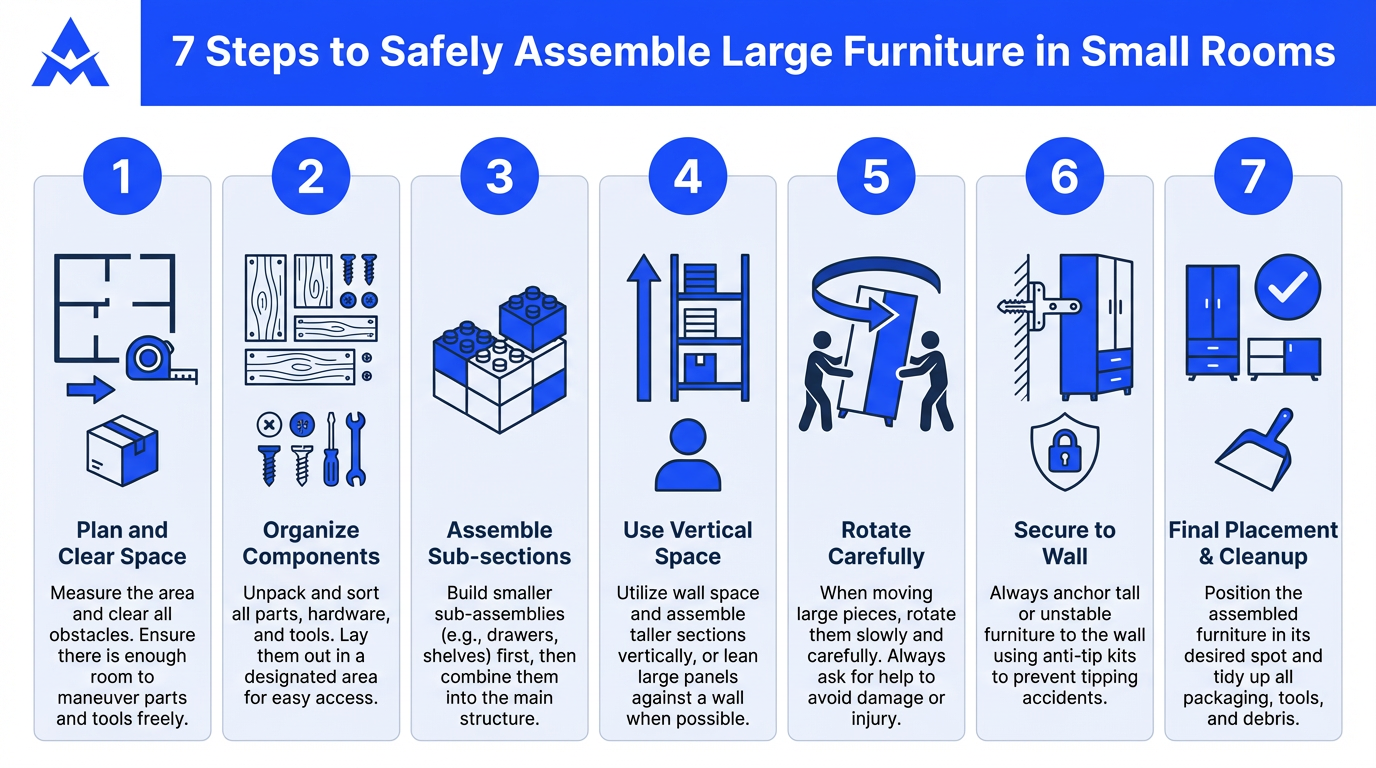
Step 1: Clear and prepare the room. Remove all other furniture and items from the assembly area to maximize the available working space before anything else is done.
Step 2: Lay down floor protection. Place moving blankets, cardboard, or furniture pads across the entire floor area before opening any boxes.
Step 3: Sort all hardware. Lay out every bolt, cam lock, dowel, and bracket before starting so nothing is lost or skipped mid-build.
Step 4: Build in sections. Assemble sub-components such as drawers and doors separately before attaching them to the main frame.
Step 5: Use two people for panel handling. Never attempt to hold and position large side panels alone in a confined space.
Step 6: Position before final tightening. Move the partially assembled unit to its final location before fully tightening all hardware so minor corrections remain possible without forcing the frame.
Step 7: Do a stability check. Before loading the unit, test for rocking, uneven footing, and a secure back panel attachment.
Partnering with professional movers and assemblers experienced in handling heavy items significantly reduces the risk of injury and property damage during large furniture setup in confined spaces.
Best Techniques to Protect Walls Floors and Corners During Assembly
Protecting walls, floors, and corners during furniture assembly requires placing barriers between every surface and furniture component before any piece is moved or lifted. Even short dragging distances cause significant surface damage when furniture panels lack protective padding underneath.
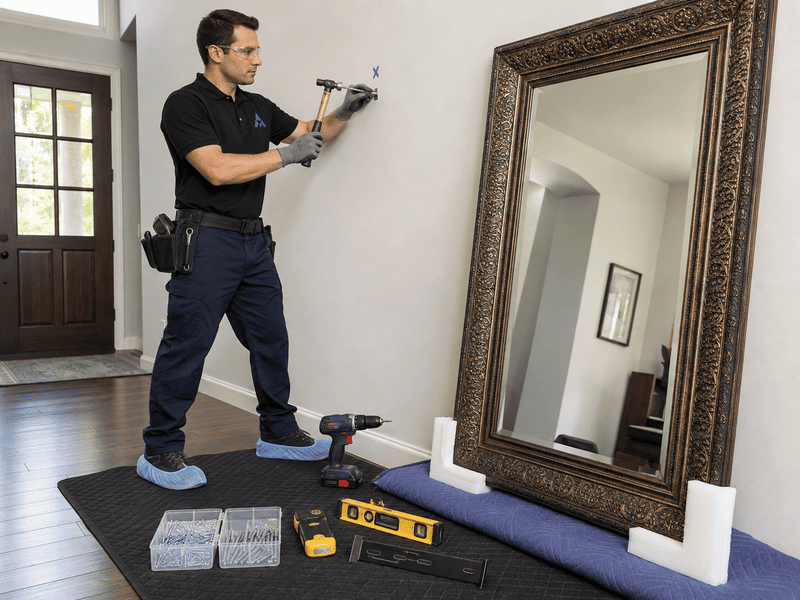
- Corner guards: Foam or rubber corner protectors on furniture edges prevent wall gouges when pieces are carried through tight doorways and rooms.
- Moving blankets: Laying thick blankets across the floor creates a cushioned work surface that absorbs impact and prevents scratches throughout the entire build.
- Wall padding: Attaching cardboard or foam panels to adjacent walls during assembly protects painted surfaces from accidental panel contact.
- Furniture sliders: Placing plastic sliders under heavy components allows easy repositioning on hard floors without dragging damage.
- Painter's tape markers: Marking the desired furniture position on the floor before assembly helps avoid multiple repositioning attempts that increase the risk of surface contact.
Professionals who specialize in tight space assembly, including those offering bookcase and shelving installation services, use these protective measures as standard practice on every job regardless of room size.
Applying these techniques consistently throughout the entire assembly process, rather than only during the final placement stage, is what prevents the majority of avoidable surface damage.
When Furniture Should Be Assembled in Pieces Instead of Fully Built
Furniture should be assembled in pieces rather than fully built when the item is too large to move through doorways once complete, when the assembly space is significantly smaller than the furniture footprint, or when the furniture design allows for modular construction.
Sofas, sectional seating, and large entertainment units are common examples of this. These items often have legs, arms, and back sections that can be detached for easier transport and then reassembled in the final room. Professional sofa disassembly and reassembly services exist specifically for this type of situation, particularly when moving large seating pieces into apartments with narrow staircases or tight doorways.
Any Assembly also offers dedicated sofa and upholstery assembly services for clients who need complex seating furniture handled with care in challenging space conditions.
The key principle is to plan your assembly pathway before building anything. If the fully assembled dimensions exceed the clearance measurements you took earlier, then a staged or partial build approach is not optional. It is the only safe method.
Tools and Equipment Professionals Use for Tight Space Furniture Assembly
Professionals use a specific set of tools designed for precision, efficiency, and surface protection when assembling furniture in tight spaces. These tools reduce the risk of over-tightening, panel damage, and hardware failure that commonly occur with standard household toolkits.
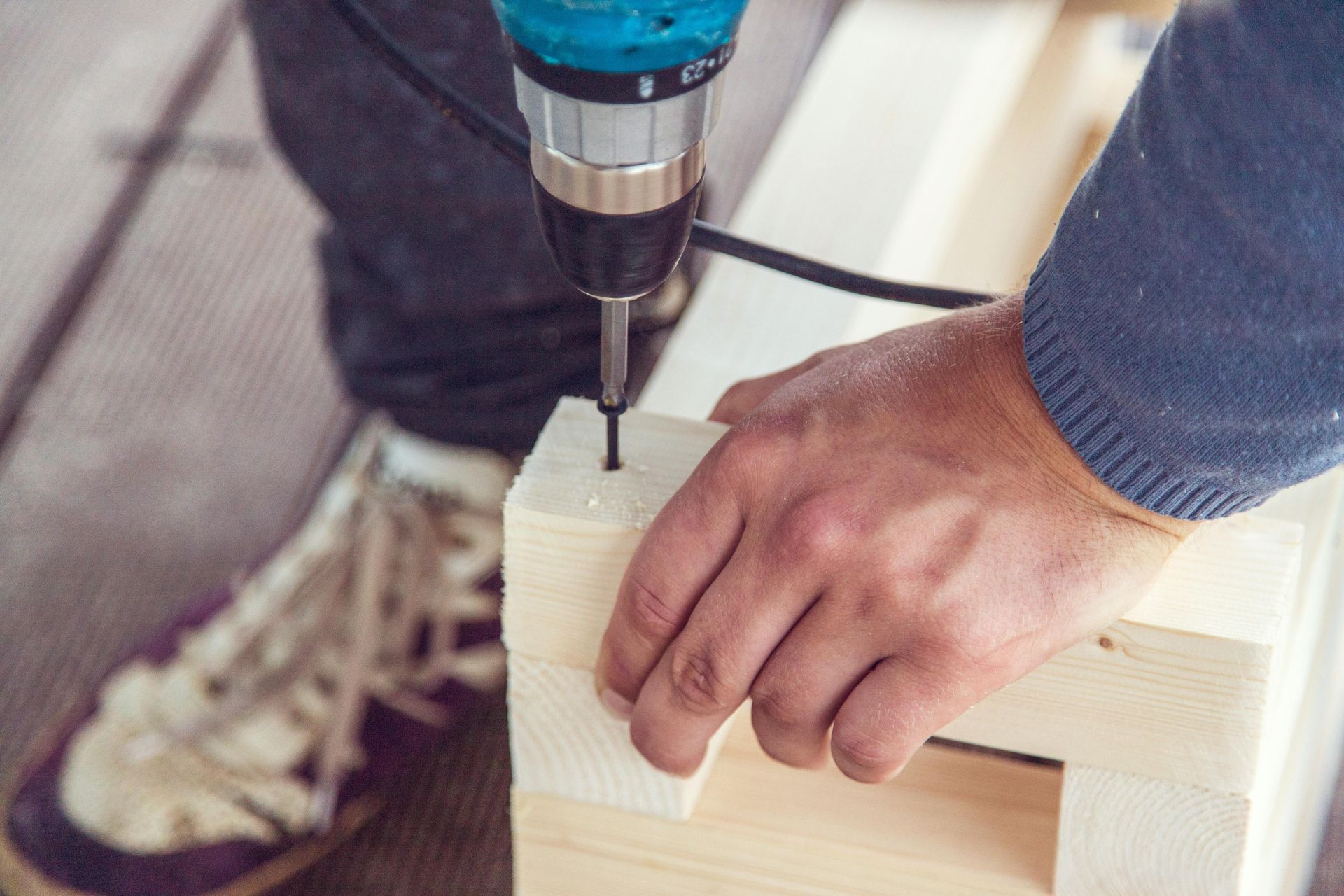
- Torque-limited electric screwdrivers: Prevent over-tightening that strips screws and splits wood panels in flat-pack furniture builds.
- Rubber mallet: Allows firm fitting of dowels and cam locks without metal-on-wood impact that cracks panels or hardware seats.
- Right-angle drill attachment: Reaches hardware in confined cabinet interiors and tight corners where standard drills cannot fit properly.
- Furniture alignment clamps: Hold panels in precise alignment while hardware is tightened, eliminating the need for a second person to hold components in place.
- Surface protection pads: Adhesive felt and rubber pads applied under furniture feet prevent floor scratches after final placement is complete.
Specialty assembly projects such as pool table and game table installation require even more specialized leveling and balancing equipment to ensure proper function in rooms where working space is limited.
Any Assembly also provides expert kitchen cabinet assembly and installation services where precise fitting in confined kitchen spaces makes professional tools an essential part of every successful job.
Why Hiring Professional Furniture Assembly Services Prevents Costly Damage
Hiring a professional furniture assembly service prevents costly damage because trained assemblers understand spatial planning, surface protection, and structural integrity. The upfront cost of professional assembly is consistently lower than the combined expense of wall repairs, floor refinishing, and furniture replacement that follows a DIY attempt gone wrong.
Professional home setup services, including expert furniture assembly and home staging support, reduce the risk of property damage and dramatically shorten the time required to complete complex room setups correctly.
For clients across the DMV region, professional furniture assembly services designed for office and home environments provide an additional layer of confidence that every build meets professional structural standards.
Any Assembly serves clients throughout Maryland, Washington DC, Delaware, Pennsylvania, and Northern Virginia. Their team handles everything from straightforward flat-pack builds to complex modular systems in even the most challenging room configurations.
Reviewing furniture assembly pricing for Maryland and DC in 2026 provides a transparent breakdown of what professional service costs compared to the potential expense of DIY repairs and rework.
Explore all services offered by Any Assembly to find the right solution for your home, apartment, or office space.
Get Professional Furniture Assembly Without Damage or Stress
Any Assembly is ready to handle your furniture assembly project safely, efficiently, and without damage to your walls, floors, or furniture. Their trained technicians serve clients across Maryland, Washington DC, Delaware, Pennsylvania, and Northern Virginia, including Baltimore, Rockville, Bethesda, Arlington, Alexandria, Wilmington, and Harrisburg.
Whether you need standard home furniture assembled, complex modular systems installed, or specialized services like game table setup and installation, Any Assembly has the expertise to complete every job right the first time.
For clients with time-sensitive or specialized needs, understanding how professionals handle emergency and specialized assembly situations demonstrates the level of preparation and response that experienced assembly teams bring to every project.
Contact Any Assembly today to request a quote and schedule your professional furniture assembly service across Maryland, DC, Delaware, Pennsylvania, or Northern Virginia.
FREQUENTLY ASKED QUESTIONS
How do you assemble large furniture in a small room without damaging the walls?
Lay down floor protection, attach corner guards to furniture edges, and place wall padding on adjacent surfaces before moving any components. Keep panels flat and low during movement, and position the piece in its final location before tilting it upright.
What is the best way to get large furniture through a narrow doorway?
Remove all doors, hinges, and any detachable legs before attempting to move the piece through a narrow opening. Carrying components separately and assembling them inside the final room is consistently safer than forcing a fully assembled unit through a tight passage.
Should I assemble furniture before or after moving it into the room?
Assemble furniture inside the room where it will be used whenever possible. Assembling large pieces outside the room and then repositioning them significantly increases the risk of wall and floor damage during movement.
How much clearance space do you need to assemble a large wardrobe or bookcase?
Plan for at least 18 to 24 inches of clear floor space on all sides of the furniture footprint during assembly. This clearance allows panels to lay flat, hardware to be installed safely, and the unit to tilt upright without contacting nearby walls or ceilings.
Can furniture assembly damage hardwood or tile floors?
Yes, dragging heavy panels and components across unprotected floors causes deep scratches, gouges, and permanent surface damage. Placing moving blankets, furniture pads, or thick cardboard under all components before and throughout assembly prevents the majority of floor contact damage.
Is it worth hiring a professional for small apartment furniture assembly?
Professional assembly in small apartments is especially valuable because confined spaces significantly increase the risk of wall and floor damage. A trained assembler plans the workspace, uses the correct protective equipment, and completes the job efficiently without the trial-and-error cycle that leads to costly repairs.
What types of large furniture are hardest to assemble in tight spaces?
Wardrobes, wall units, bunk beds, and modular shelving systems are among the most difficult furniture types to assemble in tight spaces because of their large panel sizes and high component counts. These pieces almost always benefit from professional assembly to avoid structural errors and surface damage.
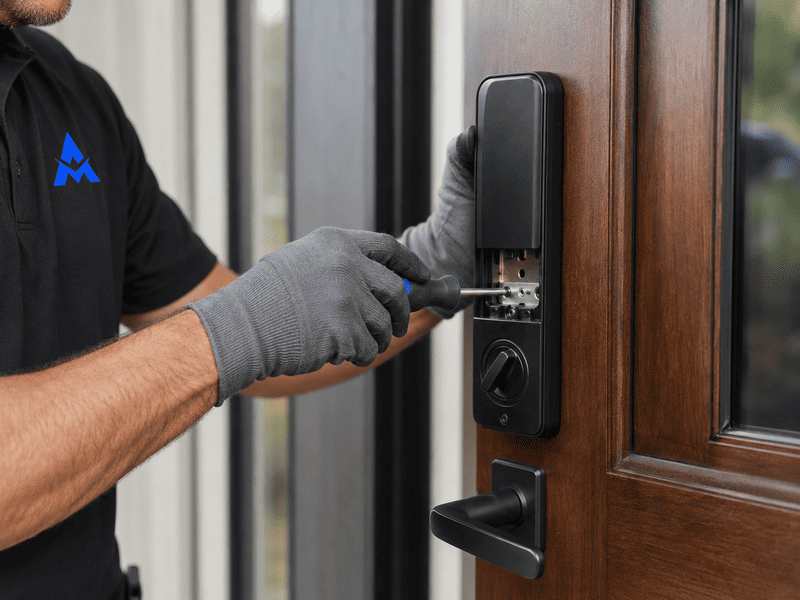
To Ease Your Move Or Redecorate Your Home Space
Follow a Few Easy Steps
Tells us your needs
Please fill up the contact form and provide us with as many details of your project as possible.
Approve Estimate
Our experts will review your project needs and create a plan that works with your schedule. You will then have to review & approve the plan via email.
Project Kick-Off
Once you have approved our solution plan, we'll send professional installers who own just the right tools & equipment in their arsenal to complete your project.
Customer Service 24/7
We’d love to hear from you. Choose the most convenient method and we’ll get back to you as soon as we can.
Contact Us
Contact Us
2707 N Rolling Rd #109, Windsor Mill, Maryland 21244
+1(410) 493-4488
VA
Any Assembly Virginia
+1(703) 596-0086
DC
Any Assembly Washington
+1(202) 684-6782
PA
Any Assembly Pennsylvania
+1(267) 209-0710