

Playset and Trampoline Installation Safety Tips Every Homeowner Should Know
Fully Licensed & Insured
Safety is our #1 Priority
Safe playset and trampoline installation starts with four essentials: stable ground, proper spacing, secure anchoring, and careful assembly that follows the manufacturer’s instructions. If any of those steps are skipped, a fun backyard upgrade can slowly turn into wobbling frames, shifting legs, hard landings, and preventable injuries.
That risk often grows after installation day. Rain softens soil, children use equipment in ways adults did not expect, and small assembly errors become bigger stability problems over time. The smartest solution is to plan the site before delivery, install the equipment correctly the first time, and use an experienced team like Any Assembly to create a backyard setup that stays safe, usable, and family-friendly for years.
What Should Homeowners Check Before Installation Day
Homeowners should confirm the exact location, ground condition, clearance zone, delivery path, and hardware requirements before installation day. It is also important to review the model instructions, verify the site is accessible, and plan for surfacing and anchoring so the finished setup is safe from the start.
A quick pre-installation review prevents the most common problems: boxes dropped too far from the build area, partially blocked swing arcs, hidden slopes, and last-minute changes after assembly begins. It also helps families avoid underestimating labor when the playset or trampoline is larger than it looked online.
Many homeowners start with models like these popular backyard playground climbers, family-friendly wooden swing sets from KidKraft, or bigger Gorilla Playsets systems with multiple accessories. As features increase, installation complexity usually increases too.
Use this simple checklist before the crew arrives:
- Measure the footprint of the equipment and the open safety zone around it.
- Check whether the yard is flat, soft, rocky, muddy, or sloped.
- Make sure gates, side yards, and fences allow easy material access.
- Decide whether you are installing new equipment or moving an existing one.
If budgeting is part of the decision, Any Assembly’s guide to backyard playset installation cost gives homeowners a useful starting point. If you are relocating an older structure after a move or yard redesign, this playset relocation cost guide can help you understand why reinstalling used equipment needs extra care.
How Does Ground Surface Affect Playset and Trampoline Safety
Ground surface affects safety by influencing stability, impact absorption, drainage, and anchor strength. A surface that looks acceptable at first can still create problems if it stays wet, shifts under load, or does not provide enough cushioning in the use zone around the equipment.
Safety surfacing is the shock-absorbing material placed under and around outdoor play equipment to reduce injury severity during falls.
Grass alone often becomes compacted and slick, especially in high-traffic areas near ladders, slide exits, and trampoline entry points. Hard-packed soil can increase impact risk, while soft, unstable soil can allow legs or anchor points to settle unevenly. That is why homeowners should think beyond appearance and focus on how the surface performs after rain, heat, and repeated use.
Practical surfacing choices often include engineered wood fiber, rubber mulch, and other impact-reducing materials recommended in broader playground safety guidance. For larger recreation zones with towers, climbers, and connected features, the same principles apply to professionally planned playground structures.
Which Safety Rules Matter Most During Assembly
The most important assembly rules are to follow the manufacturer’s sequence, tighten hardware correctly, confirm frame alignment, protect the use zone, and install anchors only after final positioning is verified. Skipping even one of those steps can leave the equipment stable enough to look finished but unsafe in real use.
Assembly is where many hidden problems begin. A frame can be square at the top and twisted at the base. A bolt can feel tight but still be seated incorrectly. A trampoline can stand upright before anchoring, yet still shift once wind or jumping forces are added. That is why professional installers work methodically instead of rushing to finish.
During setup, these rules matter most:
- Build on a clear, measured site, not by eye.
- Tighten bolts to the correct specification, then recheck after leveling.
- Keep children and pets away from the assembly area until the final inspection is complete.
- Confirm ladders, slide exits, nets, and swing hardware move freely without interference.
- Compare the finished installation against the manufacturer checklist and applicable consumer product safety standards.
The same discipline used in residential work becomes even more critical at scale, which is easy to see in professional trampoline park installation projects. Homeowners do not need a commercial setup, but they do benefit from the same focus on alignment, spacing, and long-term structural safety. Many of those advantages are also covered in Any Assembly’s article on reasons to hire a professional playground installer.
Can Poor Installation Increase Injury Risk Over Time
Poor installation can increase injury risk over time because small setup mistakes usually worsen with weather, movement, and repeated use. What starts as a slightly off-center frame or weak anchor point can turn into instability, uneven wear, loose hardware, and harder falls months later.
This is especially common when a structure is assembled on soft or uneven ground, when bolts are not rechecked after the frame settles, or when the original use zone is too tight. Children may adapt to a shaky ladder or sloped deck without realizing it is becoming more dangerous.
Older equipment deserves extra caution. Wood can split, metal can corrode internally, and reused hardware may no longer hold as designed. If a family is moving an existing set to a new property, reinstallation should never be treated like a simple copy and paste project. That is why many homeowners review this playset relocation cost guide before deciding whether to rebuild, repair, or replace.
How Much Space Should Be Left Around a Playset or Trampoline
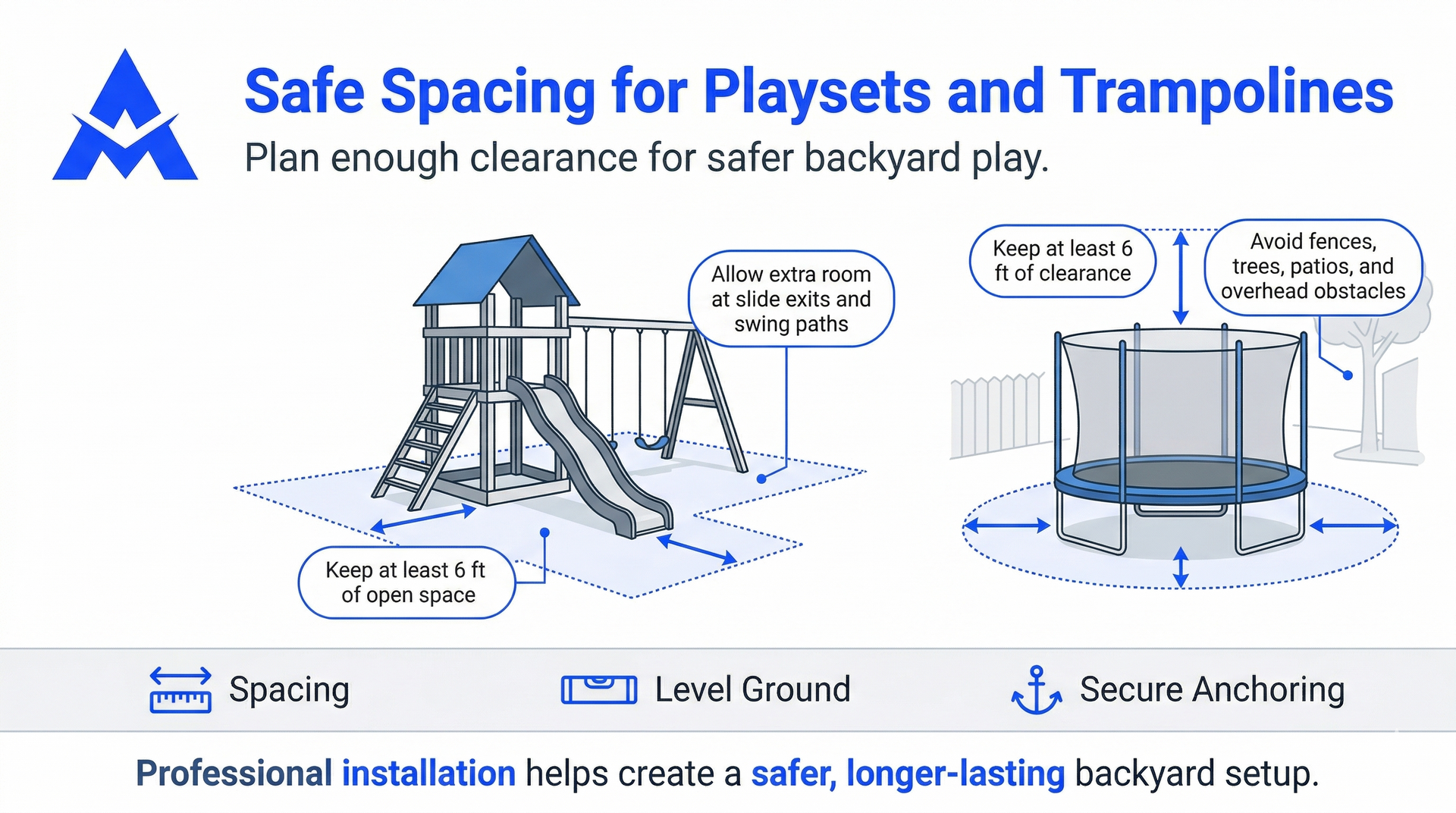
Most homeowners should leave at least 6 feet of clear space around a playset or trampoline, and more where movement extends outward, such as swing arcs, slide exits, ladders, and enclosure entry points. Overhead clearance matters too, especially near trees, roofs, wires, and fences.
The goal is not just to fit the equipment into the yard. The goal is to protect the space children actually use while climbing, landing, entering, exiting, and circling around it. Tight placement next to a fence, patio edge, retaining wall, or grill area can turn a normal fall into a much more serious impact.
When planning a safer layout, keep these spacing priorities in mind:
- Maintain open clearance on all sides, not just where the frame ends.
- Leave extra room in front of slides, swings, and entry ladders.
- Keep trampolines away from hardscapes, trees, and overhead obstructions.
- Plan the full backyard recreation zone if you want more than one feature.
That bigger-picture planning matters when families want a trampoline, playset, and hoop in the same yard. Resources like this guide to the best basketball hoops for small driveways and limited space show how quickly shared recreation areas can become crowded. If you need help mapping a safer overall setup, Any Assembly’s assembly and installation services can support broader backyard planning as well.
What Anchoring Mistakes Should Homeowners Avoid
Homeowners should avoid anchoring before final leveling, using the wrong anchor type for the soil, placing anchors too shallow, and assuming weight alone will keep the equipment stable. Proper anchoring is what helps outdoor play equipment resist shifting, tipping, and wind-related movement.
One common mistake is anchoring a playset or trampoline into soil that later settles after rain. Another is forcing a standard anchor into rocky ground without adjusting the method. Even when the structure feels sturdy on day one, it may loosen after a season of jumping, climbing, and changing weather.
Anchoring must match both the equipment and the site. Accessory-heavy systems, swing beams, and elevated decks place stress on the frame in ways lighter units do not. That is why the same precision used for swing set assembly and installation should also guide backyard playset anchoring and safe trampoline setup.
Why Level Placement Matters for Outdoor Play Equipment
Level placement matters because outdoor play equipment is designed to distribute force evenly across its frame. When the ground is not level, weight shifts unevenly, hardware loosens faster, and moving parts like swings, slides, and trampoline mats stop performing the way they were designed to.
A slight slope may not be obvious during installation, yet it can create visible issues later. Swings may hang unevenly, ladder footing may feel unstable, and water may collect under one side of the equipment. Over time, that imbalance can speed up wear and make routine use less predictable for children.
Level placement is especially important in sloped yards, newly landscaped backyards, and family play areas where surface drainage changes throughout the year. Professional installers know how to assess grade before assembly begins so the finished structure sits correctly and stays that way.
How Weather and Wear Can Affect Long Term Safety
Weather and wear affect long-term safety by loosening hardware, weakening surfaces, softening soil, fading protective materials, and increasing stress on high-use points. Even a properly installed playset or trampoline needs periodic inspection because outdoor exposure changes how the equipment performs over time.
Rain and freeze-thaw cycles can shift anchor strength. Sun exposure can dry and crack wood, fade plastic, and weaken pads or netting. Wind places repeated force on trampolines, while humid conditions can accelerate rust on metal connections. These changes often happen gradually, which is why they are easy to overlook.
Homeowners should inspect hardware, anchor points, surfacing depth, ladder stability, and enclosure condition at regular intervals. That same long-term mindset matters for other backyard systems too, especially more complex playground structures. If the equipment no longer feels stable, professional adjustment or reinstallation is usually safer than quick DIY fixes.
Build a Safer Backyard Setup From Day One
The safest backyard setups are planned before the first part is unpacked and installed by professionals who understand spacing, anchoring, leveling, and long-term outdoor performance. That is why hiring Any Assembly is often the smarter choice for homeowners who want a safe, durable play area instead of a trial-and-error weekend project.
Any Assembly helps families create safer play zones for homes and backyards across Maryland, Washington DC, Delaware, Pennsylvania, and Northern Virginia, including Baltimore, Rockville, Bethesda, Arlington, Alexandria, Wilmington, and Harrisburg. Whether you are dealing with a sloped yard, limited spacing, or a larger family recreation layout, their team can install outdoor play equipment with the care that long-term safety requires.
If you are ready to upgrade a family play area, start with Any Assembly’s contact page and request professional help. Many customers also need support beyond backyard equipment, from shelving installation for garages, utility rooms, and workspaces to planning interiors shaped by modern office design trends and furniture installation strategies, or even fast emergency furniture disassembly services for moving day issues.
For families who want safety, stability, and smart use of space from day one, professional installation is the better investment.
Key Takeaways
- Check the yard before installation day by measuring the footprint, reviewing access, confirming soil conditions, and planning surfacing and anchors.
- Surface choice matters because it affects both fall protection and structural stability after rain, heat, and repeated use.
- Safe spacing should protect the full use zone around the equipment, not just the frame itself, especially near slides, swings, and trampoline entries.
- Proper anchoring and level placement help prevent shifting, uneven wear, and instability that can grow worse over time.
- Weather exposure changes how outdoor play equipment performs, so regular inspection is part of long-term safety.
- For homeowners who want a safer, longer-lasting setup, professional installation from Any Assembly is often the smartest move.
FREQUENTLY ASKED QUESTIONS
How long does playset or trampoline installation usually take?
Most standard trampolines can be installed in a few hours, while larger playsets often take much longer depending on size, accessories, and ground preparation. If leveling, anchoring, or surfacing is needed, the project timeline can extend further.
Does a backyard trampoline need to be anchored?
Yes, most backyard trampolines should be anchored to reduce shifting and wind movement. Anchoring is especially important in open yards, storm-prone areas, and places where soil softens after rain.
What ground surface is safest under a playset?
Impact-absorbing surfacing is generally safer than bare dirt or worn grass because it can reduce injury severity during falls. The best option depends on the equipment, drainage, maintenance needs, and the manufacturer’s recommendations.
How much clearance is needed around backyard play equipment?
A good rule is to leave at least 6 feet of open space around the equipment, with more room where children move outward. Slides, swings, trampoline entries, and overhead obstructions usually require extra clearance.
Can uneven ground make a playset unsafe?
Yes, uneven ground can make a playset unstable and can cause hardware and moving parts to wear unevenly. Even a small slope can change how weight is distributed across the structure over time.
How does weather affect trampoline safety over time?
Sun, rain, wind, and freezing temperatures can all weaken trampoline parts or change ground stability. Pads, nets, springs, anchors, and frame connections should be checked regularly throughout the year.
When is professional installation better than DIY?
Professional installation is usually the better choice when the equipment is large, the yard is sloped, the model has many accessories, or safe anchoring is not straightforward. It is also a smart option when homeowners want the structure assembled to manufacturer specifications the first time.
Can an old playset be relocated and reinstalled safely?
Yes, an old playset can sometimes be relocated safely, but only after checking for damaged wood, worn hardware, missing parts, and changes in the new yard. Reinstallation often takes more planning than people expect because older structures may not go back together exactly like new ones.
To Ease Your Move Or Redecorate Your Home Space
Follow a Few Easy Steps
Tells us your needs
Please fill up the contact form and provide us with as many details of your project as possible.
Approve Estimate
Our experts will review your project needs and create a plan that works with your schedule. You will then have to review & approve the plan via email.
Project Kick-Off
Once you have approved our solution plan, we'll send professional installers who own just the right tools & equipment in their arsenal to complete your project.
Customer Service 24/7
We’d love to hear from you. Choose the most convenient method and we’ll get back to you as soon as we can.
Contact Us
Contact Us
2707 N Rolling Rd #109, Windsor Mill, Maryland 21244
+1(410) 493-4488
VA
Any Assembly Virginia
+1(703) 596-0086
DC
Any Assembly Washington
+1(202) 684-6782
PA
Any Assembly Pennsylvania
+1(267) 209-0710